_edited.png)
Every Second Counts
- PoolPro Inspectors
- Mar 15
- 7 min read

Updated: May 25
The Devastating Reality of Child Drowning in Australia
If you have a backyard swimming pool, this article is written for you. Read it before summer. Read it before your next family barbecue. Read it before you prop that gate open ‘just for a moment.’
Drowning does not look the way it does in the movies. There is no splashing. There is no screaming for help. A child who enters a backyard pool unattended can be underwater, unconscious, and beyond help in as little as 20 seconds — silently, while a parent or carer is metres away. This is not a remote risk. This is what Australia’s national data shows, year after year, in pools just like yours.
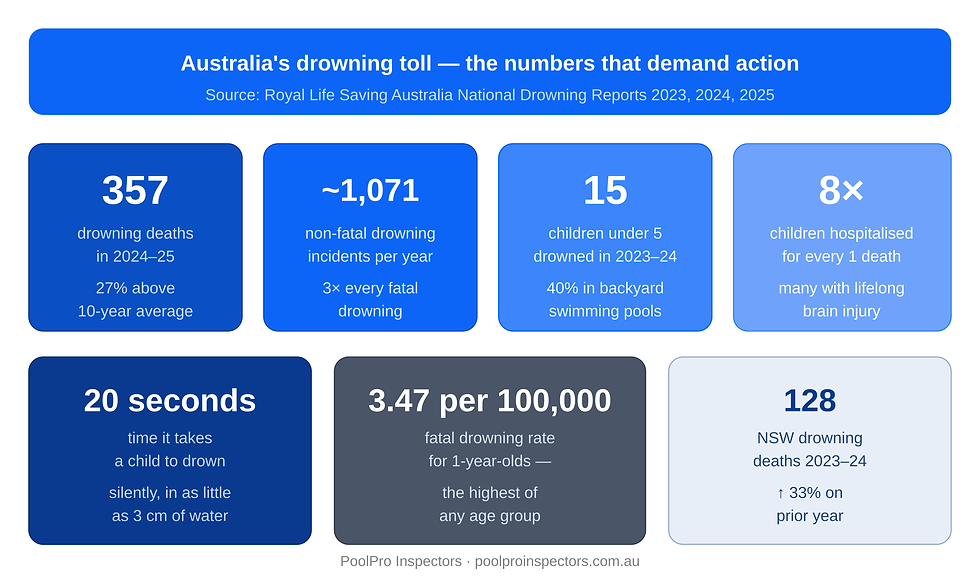
Figure 1: Key drowning statistics — Australia 2023–2025. Source: Royal Life Saving Australia National Drowning Reports.
The national picture: a crisis in plain sight
The National Drowning Report 2025, published by Royal Life Saving Australia in partnership with Surf Life Saving Australia, recorded 357 drowning deaths over the past 12 months — a figure 27% higher than the ten-year average. These are not statistics about distant strangers. NSW alone recorded 128 drowning deaths in 2023–24, an increase of 33% on the prior year.
But fatal drownings are only part of the story. For every fatal drowning, approximately three more people experience a non-fatal drowning incident requiring hospitalisation or resulting in lifelong injuries — meaning in 2023–24 there were close to 1,292 drowning incidents across Australian waterways. Most survivors consider themselves fortunate. Many are not. The injuries that follow a near-drowning can be as catastrophic as death itself.
Children under five: the most vulnerable of all
Children under five are curious, quick, and fearless. Their love of water puts them at very serious risk. Each year in Australia, on average 19 young children lose their lives to drowning, with half of these tragedies occurring in backyard swimming pools. The majority are aged just one year old — because the risk of drowning triples at this age when children become more mobile.
One-year-old toddlers record the highest fatal drowning rate of any age group in Australia, at 3.47 deaths per 100,000 population. That is not a number about adventure playgrounds or natural waterways. It is about the pool in the backyard of an ordinary Australian home.
Between 2002–03 and 2019–20, 507 children aged 0 to 4 years drowned in Australia. Of these, 207 — 41% — were aged just one year. Most deaths of one-year-olds occurred in backyard swimming pools, accounting for 53% of that age group’s fatalities. Accidental falls into water were the leading activity, accounting for 78% of all deaths. Almost all occurred due to a lapse in active adult supervision.
“Toddlers are attracted to water, but they don’t yet understand the dangers. A split second is all it takes for them to find themselves in trouble.” — Professor Richard Franklin, Kidsafe Australia President
The grief shared by one mother, Josie Costanzo, has become a warning known across Australian water safety circles. Her three-year-old son Justin drowned in a neighbour’s pool after the gate had been propped open with a rock. “Justin died in less than 20 seconds with a mouthful of water in his lungs. I still had his dinner plate in my hand when I heard a call from my daughter and looked out the window to see him in the pool.”
Twenty seconds. A dinner plate still in her hand.
Recent incidents that made the news
The statistics become impossible to dismiss when you read the individual incidents behind them.
January 2025 — Three-year-old Australian girl, Bali
A three-year-old Australian girl tragically drowned in a private villa pool in Kerobokan, Bali, during a family holiday. Despite her father’s efforts to pull her from the water and rush her to hospital, she was pronounced dead on arrival. Just months earlier, in October 2024, 14-month-old Khyden James drowned in a villa pool in the same area of Bali. Both incidents drew renewed calls from safety experts about the risks families face at destinations without Australia’s strict pool safety standards.
January 2026 — Three-year-old girl, Freshwater NSW
A three-year-old girl was pulled unconscious from the bottom of a backyard saltwater pool at Freshwater on Sydney’s Northern Beaches. Family members commenced CPR immediately after calling Triple Zero. Four NSW Ambulance crews responded, including Intensive Care Paramedics and a rescue helicopter. The girl was airlifted to Sydney Children’s Hospital in a critical condition. The family’s CPR — delivered in those desperate seconds before help arrived — is what kept her alive.
Late 2024 — South Australia government warning
South Australian authorities issued urgent public warnings after a series of drowning incidents, confirming that in 2023 alone, 10 children under five required treatment — eight for near-drownings and two who died. Authorities confirmed that most involved private pools, non-compliant fencing, open or unlocked gates, and lapses in supervision.
These are not isolated tragedies. They are the foreseeable, documented, preventable consequence of barriers that failed — or were never there at all.
What a near-drowning does to a child’s brain
Here is what many parents do not know: surviving a pool incident is not the same as recovering from one.
For every child who dies, around eight more are hospitalised following a non-fatal drowning incident — that is more than 150 children aged under five every year. Some of these children are left with life-limiting, permanent disabilities.
When a child’s brain is deprived of oxygen — even briefly — the damage can be permanent. Research published from NSW paediatric hospitals found that even among children who showed no apparent neurological problems on hospital discharge after a non-fatal drowning, 22% showed behavioural problems, poor communication, executive function difficulties, and learning difficulties during their five-year follow-up.
One NSW mother described what happened after her one-year-old child fell into a home swimming pool: “We think that the child squeezed through the fence of the swimming pool. Child now has brain damage from the incident and is having ongoing rehab.” — Source: Published research, NSW paediatric hospitals (PMC9683605)
The NSW Ombudsman’s Child Death Review Team found that of children who drowned in private NSW swimming pools studied, 33 out of 37 pools did not have a functioning safety barrier. Nine pools had no fencing at all. Of those children who gained access to fenced pools, the majority did so through faulty gates or gates that were propped open. In every single case, the child drowned in the absence of adult supervision.
How children get in: the four ways a pool fence fails
Royal Life Saving Australia has identified four main ways children gain access to backyard pools: a faulty fence or gate; the absence of a fence; the gate being deliberately propped open; and the child climbing over the fence, often using pool furniture or pot plants next to the fence to gain a foothold.
The data on propped gates is particularly confronting. Research shows that 24% of children aged 0–4 who drowned in home pools accessed the pool because the gate was deliberately propped open — not a broken latch, not a climbing child, but a gate held open by an adult, for convenience, for a moment.

Figure 2: How children gained access before drowning in home pools. Source: Royal Life Saving Australia, NSW Ombudsman CDRT, Queensland coronial data.
Landmark Australian research found that in not one case did a child gain unaided access to a pool fitted with a fully functional gate and fence that met the Australian standard. The fence works. It only fails when it is not there, not maintained, or not closed.
What pool owners must do — right now
The evidence is clear and the actions are simple. There is no ambiguity here.
• Check your gate today.
Walk to your pool gate and close it behind you. Does it self-close from any position? Does the latch engage automatically without you touching it? If the answer to either question is no, call a certified pool inspector or fencing contractor before this weekend.
• Never prop the gate open.
Not for a barbecue. Not while you carry groceries in. Not for a moment. One in four child drowning deaths in home pools occurs because a gate was propped open by an adult. You may be right next to the pool. 90 seconds is enough.
• Remove anything climbable within 900 mm of the outside of the fence.
Chairs, eskies, pot plants, bicycles, stored equipment — all have been identified in drowning investigations as the foothold a child used to get over an otherwise-compliant fence. Walk the perimeter now.
• Know CPR.
Research from NSW paediatric hospitals found that 45% of children in the incidents studied did not receive CPR at all — partly because the stress of the incident rendered some parents unable to act. Training before a crisis is the only way to know you will act during one.
• Supervise actively — without exception.
No fence replaces eyes. Children under four should be within arm’s reach at all times near water. Children under ten must remain in your direct line of sight. Phones, conversations, and cooking do not qualify as supervision.
• Book a compliance inspection.
Royal Life Saving Australia has confirmed that many drowning deaths involve barriers that are faulty, not maintained, propped open, or non-compliant. A registered E1 certifier will identify every deficiency in your barrier before a tragedy makes that information irrelevant.
Child Drowning Prevention and Pool Safety: The Fence That Has Never Been Beaten
The evidence accumulated over 30 years of Australian drowning research leads to one undeniable conclusion: in not one documented case has a child gained unaided access to a pool through a fully functional, compliant gate and fence that met the Australian standard.
Royal Life Saving’s National Medical Adviser Professor John Pearn AO has stated that the introduction of mandatory fencing for backyard pools in the 1990s was a pivotal moment in child safety in Australia. Safety barriers around backyard pools have saved thousands of toddlers’ lives in recent decades. But they must be well maintained, and children must always be supervised around water.
The barrier works. Maintaining it is not a legal formality — it is the difference between a summer afternoon and a coroner’s report.
If you have a pool and you are reading this, please stop. Walk outside. Check the gate. Check the latch. Walk the fence line. Remove anything within 900 mm. Then book an inspection. Do it today. Not this weekend. Today.
PoolPro Inspectors is a registered Pool Certifier operating across NSW. For CPR resources and drowning prevention guidance, visit royallifesaving.com.au. Sources: Royal Life Saving Australia National Drowning Reports 2023, 2024 and 2025; NSW Ombudsman Child Death Review Team; Australian Institute of Health and Welfare; NSW Swimming Pool Register; PMC9683605 (non-fatal drowning, NSW paediatric hospitals); PMC1730669 (toddler drowning, domestic pools); MDPI 2017 (Queensland pool fencing legislation); Premier of South Australia media release, December 2024; The Bali Media, January 2025; Northern Beaches Advocate, January 2026.


Comments